
Peeling Paint on Walls and Ceilings in Macon GA: Causes and Fixes
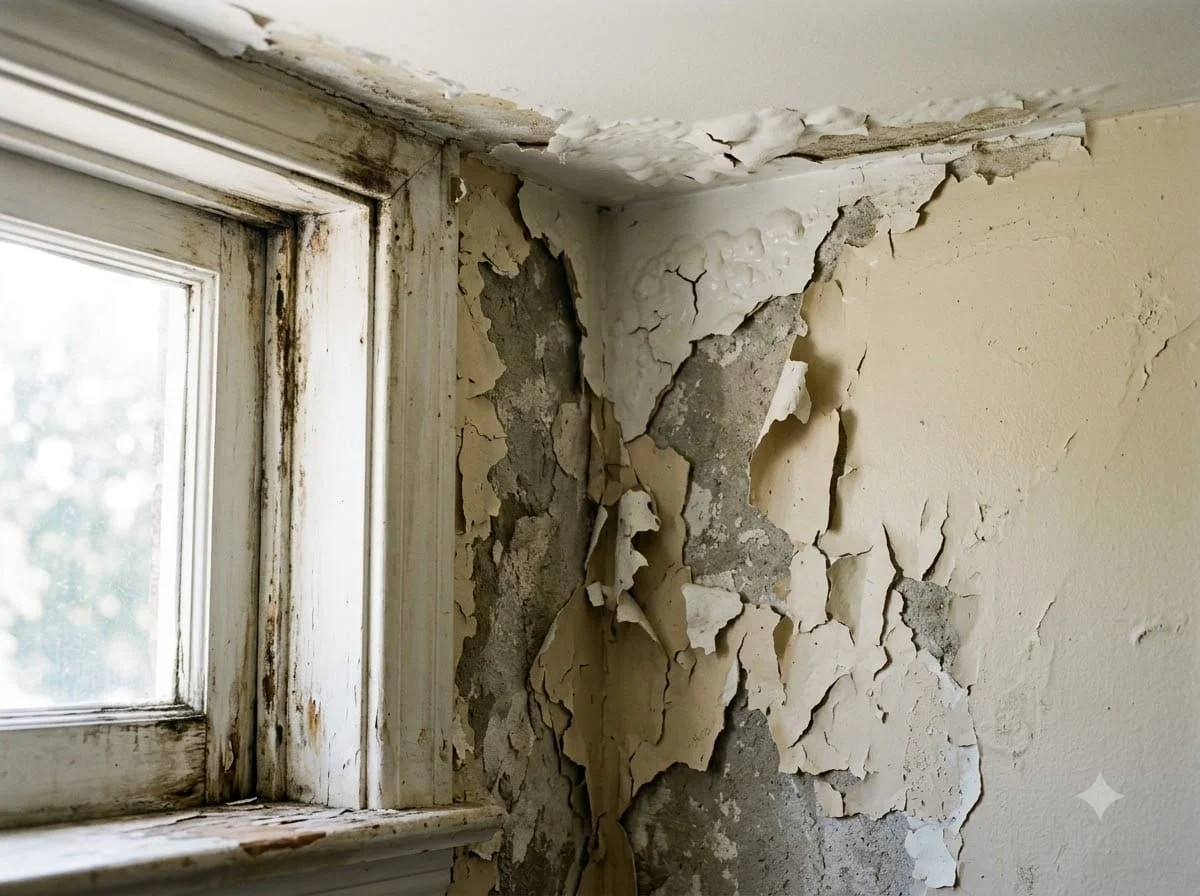
Peeling paint traces to one of two causes — moisture reaching the film from behind, or a bond that never properly formed with the surface underneath. Repainting without identifying which one you have produces the same peeling within 12 to 24 months, at $250 to $600 per ceiling each time you do it.
Those two causes look similar from across the room and require completely different repairs. Moisture failures need the water source found and stopped before a brush comes out. Adhesion failures need the surface itself corrected, which usually means the right primer rather than more paint.
Macon adds a third factor that most of the country does not deal with as sharply. Central Georgia runs 45 to 50 inches of rain a year with summer dew points sitting in the 70s for months, and the city's older neighborhoods are full of plaster ceilings finished with a material that modern paint simply will not stick to.
When Handyman Macon GA looks at peeling paint, we are reading the pattern first — because the pattern tells you the cause before anything gets touched.
How to Read Your Peeling Paint
Reading peeling paint takes a few minutes and tells you most of what you need. The shape, location, and edge of the failure each point somewhere specific.
Bubbles or blisters that appeared before the peeling mean moisture from behind. Water vapor pushing outward lifts the film off the substrate, and it dries into a blister that eventually breaks and flakes.
Find the water first — a roof leak, a supply line in the wall, a shower pan, or a bathroom running without ventilation.
Peeling in large sheets from a plaster ceiling in a pre-1930 home is almost certainly calcimine, covered in detail below. The giveaway is that the sheet comes away clean and the back of it carries a chalky white residue.
Flaking in small chips revealing paper or bare drywall means paint was applied to an unprimed or dusty surface. Drywall paper needs primer, and joint compound is porous enough to pull the binder out of a topcoat applied directly to it.
Peeling confined to one bathroom is ventilation. A shower puts several pints of water vapor into a small room, and without an exhaust fan running long enough to clear it, that moisture condenses on the coolest surface — usually the ceiling.
Peeling only along the bottom of a wall is wicking. Moisture is entering at the floor line, typically from a damp crawl space or slab, and rising through the wall material.
Alligatoring — a cracked pattern like dried mud — means incompatible or excessively thick layers, most often aged oil paint under latex. It is an adhesion failure between coats rather than at the wall.
Peeling on interior masonry or new plaster is likely alkali burn. Fresh masonry, mortar, and plaster are highly alkaline, and that alkalinity chemically attacks the binder in ordinary latex paint applied too soon or without a masonry primer.
The Calcimine Ceiling Problem in Macon's Older Homes
Calcimine is the single most misdiagnosed cause of peeling ceilings in Macon, and it shows up constantly in the pre-1930 housing stock across College Hill, Huguenin Heights, Vineville, and the converted buildings downtown.
Calcimine — also called distemper or whitewash — was a finish made from chalk, water, and animal glue, brushed onto plaster ceilings as the standard treatment of the era.
It was never meant to be permanent. Calcimine was designed to be washed off and reapplied every few years, which is exactly what households did until the practice faded mid-century.
The failure happens when modern paint goes over it. Latex forms a strong, continuous, flexible film that grips the calcimine layer tightly — and the calcimine's own grip on the plaster is weak and water-soluble.
The new paint is now stronger than the thing holding it up. As soon as humidity works into that chalk-and-glue layer, it releases, and the paint comes off in sheets the size of dinner plates or larger, carrying a chalky white powder on its back.
Scraping and repainting a calcimine ceiling reproduces the failure, usually within a year or two. Two approaches actually work.
The first is washing the calcimine off completely with warm water and a sponge until the plaster is clean, which is slow, wet, and the more thorough option. The second is sealing it with a shellac-based primer, which penetrates and locks down the chalk layer in a way latex and most oil primers do not.
Choosing between them depends on how much calcimine remains and how sound the plaster underneath is, and that is a judgment made on a ladder rather than from a description.
Why Central Georgia Humidity Makes All of This Worse
Central Georgia humidity attacks paint at two separate stages, and homeowners usually only think about one of them.
During application, summer dew points in Macon sit in the 70s from June through September. Latex paint cures by evaporation, and evaporation slows dramatically as the air approaches saturation.
A coat applied on a humid July afternoon can stay soft for days, and moisture trapped in a film that never fully coalesced produces a coating with poor adhesion and poor durability from day one. Running the air conditioning during and after interior painting is not a comfort measure — it is part of the process.
After application, sustained indoor humidity keeps drywall, plaster, and joint compound at elevated moisture content. Wall materials that stay damp week after week hold paint less well than dry ones, which is why rooms above damp crawl spaces peel while the rest of the same house does not.
This is the same mechanism that drives so much of what Handyman Macon GA sees in post-war neighborhoods like East Macon, and it connects directly to what we cover in our guide to water damage drywall repair.
The pollen problem nobody accounts for
Exterior painting in Macon has a season, and late March is not it. Central Georgia's pine pollen bloom coats every horizontal and vertical surface in the city with a fine yellow film for several weeks each spring, right around the Cherry Blossom Festival.
Paint applied over that film bonds to pollen rather than to the substrate, and pollen is not a durable foundation for anything.
Exterior work that has been washed, prepped, and primed still needs a genuinely clean surface at the moment the topcoat goes on, and during a heavy pollen week a surface washed in the morning is contaminated again by afternoon. We schedule exterior painting for after the bloom clears rather than fighting it, and it is worth planning around for homeowners doing the work themselves.
How to Fix Peeling Paint Properly
A repair that lasts follows the same sequence every time, and the order matters more than the products do.
First, find and stop the moisture source. If the failure showed blisters, nothing else on this list matters until the water is dealt with. That may be a roof, a flashing detail, a supply line, a shower pan, or simply a bathroom fan that vents into an attic instead of outside.
Second, test for lead if the home predates 1978. This determines how the next step is performed, so it comes before scraping rather than after.
Third, scrape back to sound material. Work outward from the failure with a stiff scraper until the paint stops coming off under firm pressure. The scraped area will always end up larger than the visible damage — that is correct, not a sign of over-working it.
Fourth, feather the edges. Sand the transition between scraped and intact paint until you cannot feel a ridge with a bare hand. Skipping this leaves a visible outline that telegraphs through the finish coat under any raking light.
Fifth, prime with the primer that matches the actual problem. Shellac-based primer for calcimine and for stains that would bleed through. Masonry or alkali-resistant primer for plaster and brick. Bonding primer for glossy or previously oil-painted surfaces. Standard latex primer for bare drywall and joint compound.
Using the wrong primer here is the most common way a careful repair still fails.
Sixth, skim coat where the surface needs it. Large scraped areas on plaster or heavily layered walls will not disappear under paint alone, and a thin skim of joint compound sanded flat is what makes the repair invisible.
Finally, topcoat with paint suited to the room. Bathrooms and kitchens want a satin or semi-gloss with mildew resistance. Ceilings want flat. Two thin coats outperform one heavy one every time, particularly in this climate.
What Peeling Paint Repair Costs in Macon
| Job | Typical Cost |
|---|---|
| Scrape, prime, and repaint one ceiling | $250 – $600 |
| Bathroom ceiling and walls | $350 – $800 |
| Single room, full prep and repaint | $400 – $900 |
| Room requiring a skim coat first | $700 – $1,600 |
| Calcimine ceiling removal + skim + paint | $900 – $2,500 per room |
| Exterior wall section — scrape, prime, paint | $400 – $1,200 |
| Moisture source diagnosis | $85 – $250 |
| Lead-safe containment (pre-1978 homes) | +$300 – $800 |
The spread within each range is almost entirely prep, not paint. A ceiling with a two-foot failure and sound paint elsewhere sits at the bottom of its range. The same ceiling with calcimine underneath sits at the top or moves into its own category.
This is also why quotes for the same room can differ by a factor of three between contractors — the cheap one is planning to paint over it. For broader interior pricing, our interior painting cost guide for Macon breaks down per-room and per-square-foot numbers.
Lead Paint in Pre-1978 Macon Homes
Lead paint deserves a direct answer rather than either alarm or dismissal. Homes built before 1978 may contain lead-based paint, and given the age of Macon's housing stock that covers a large share of the city — nearly all of the historic neighborhoods and a good portion of the post-war ones.
Intact, undisturbed lead paint is not a hazard. The risk comes from disturbance. Scraping, sanding, and heat-stripping all convert a stable coating into airborne dust and settled particles, and that dust is the actual exposure pathway, particularly for young children.
Swab test kits are inexpensive and available at any hardware store for a first check. Where lead is present and the area is significant, the work should follow lead-safe practices.
That means plastic containment, wet methods rather than dry sanding, HEPA vacuuming, and careful cleanup. This is a real consideration on exactly the pre-1930 ceilings where calcimine problems also live, which is why we test before scraping rather than during.
DIY vs Calling a Pro
Small interior patches are reasonable DIY work. A two-foot area of failed paint on a modern drywall wall in a post-1978 home is a scraper, a sanding sponge, a quart of primer, and an afternoon. The materials are cheap and the downside of a mediocre result is cosmetic.
Three situations are worth handing off. Ceilings peeling in sheets in an older home, because calcimine diagnosis and treatment is specific work and doing it wrong wastes the entire effort. Anything where the cause is moisture you have not located, because the painting is the last five percent of that job. And any significant disturbance of pre-1978 paint, because containment and cleanup are what actually protect the household.
Recurring failures are the other honest signal. If a spot has been repainted twice and peeled twice, the diagnosis is what is missing, not the effort.
Get a Painting Estimate in Macon
An accurate answer on peeling paint requires seeing the failure edge and the back of a flake, because the residue on the underside is what identifies the cause. Call (877) 368-1249 or use the contact form to schedule a free estimate. We identify whether it is moisture, adhesion, or calcimine, find the water source if there is one, and put the scope in writing before anything is scraped.
Our interior and exterior painting service in Macon covers prep, priming, plaster and drywall repair, and lead-safe practices across Bibb County. Where the underlying surface has failed rather than the coating, that becomes drywall and plaster repair instead. Houston County homeowners can find the same work on our painting in Warner Robins page.
Frequently Asked Questions
- Because the cause was covered rather than removed. Paint that peels repeatedly in one place is almost always being pushed off from behind by moisture — a roof or plumbing leak, a bathroom without working ventilation, or humid air condensing on a cool exterior wall. Paint is a film, and no film bonds to a surface that is wet from the other side. Until the source is stopped, every repaint fails again on roughly the same schedule.
- That is usually calcimine, common in Macon homes built before roughly 1930. Calcimine was a chalk-and-glue distemper used on plaster ceilings and was never meant to be painted over. Modern latex bonds to the calcimine rather than the plaster, and as the calcimine releases the paint comes away in sheets carrying chalky residue. Scraping and repainting does not solve it — the calcimine must be washed off or sealed with a shellac-based primer.
- Scraping, priming, and repainting one ceiling runs $250–$600. A bathroom ceiling and walls together run $350–$800. A full room with proper prep runs $400–$900, and a room needing a skim coat first runs $700–$1,600. Calcimine ceiling removal with re-skimming and paint runs $900–$2,500 per room. Lead-safe containment on pre-1978 homes adds $300–$800 depending on the area involved.
- No, and it is the most expensive shortcut in painting. New paint bonds to whatever it lands on, so applying it over loose flakes bonds it to loose flakes. It also shrinks slightly as it cures, putting tension on the failing layer and frequently pulling off more than was peeling before you started. Every failing edge must be scraped back to material that is genuinely stuck, then feathered and primed. The prep is the job.
- It contributes in two ways. During application, summer dew points in the 70s slow curing and can trap moisture in the film, producing a coating that never reaches full hardness or adhesion. After application, sustained indoor humidity keeps drywall, plaster, and joint compound at elevated moisture content, weakening the bond over time. That is why bathrooms without working exhaust fans and rooms over damp crawl spaces peel while the rest of the house does not.
- If the house was built before 1978, assume lead is present until a test says otherwise — that covers most of Macon's historic neighborhoods. Lead paint is not dangerous while intact and undisturbed. It becomes a hazard when scraped, sanded, or heat-stripped, because that puts lead dust into the air and onto floors. Inexpensive swab tests work for a first check, and significant disturbance should follow lead-safe containment practices.