
Drafty Windows and Doors in Macon GA: Causes, Fixes, and Energy Savings
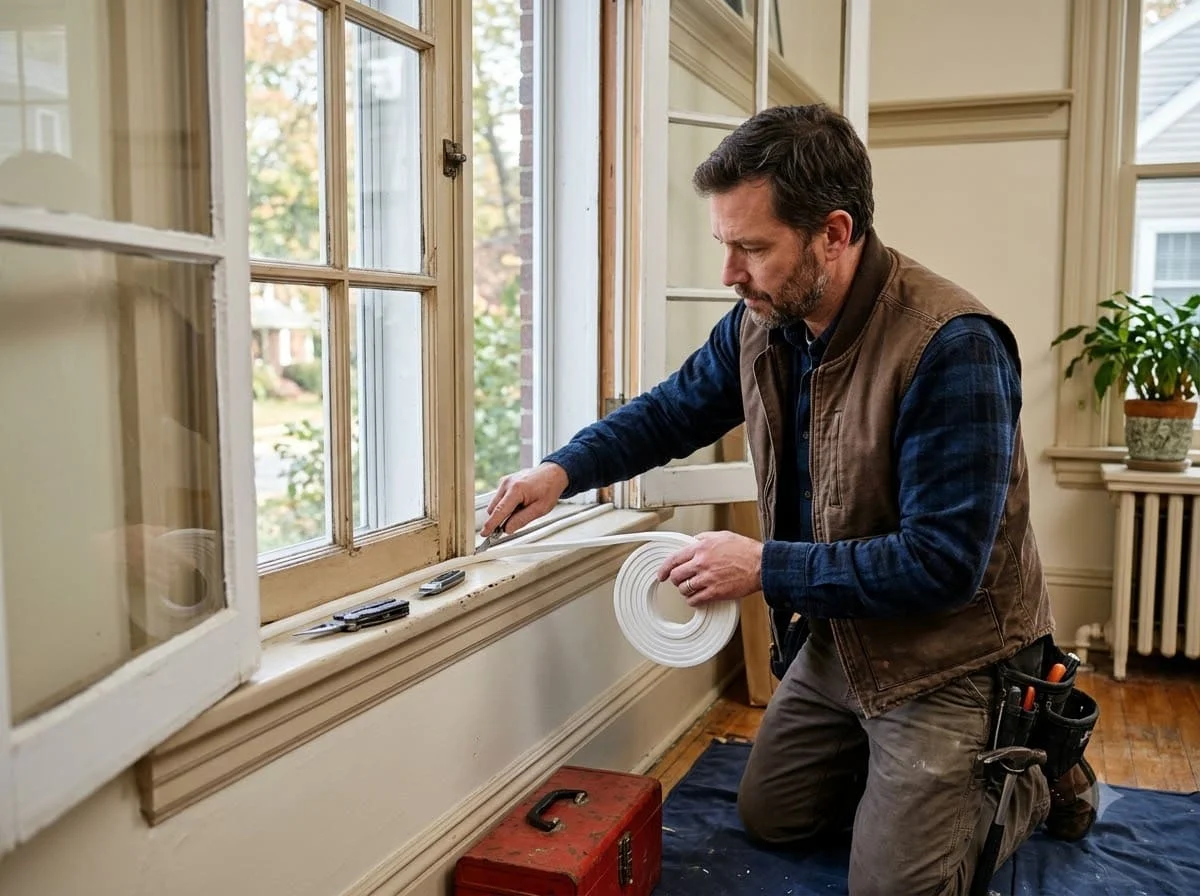
A drafty window is almost never leaking through the glass. It is leaking around it — at the check rail, at the jambs, through the sash weight pockets, and behind the exterior casing. That distinction is the whole reason a $150 weatherstripping job frequently outperforms what homeowners expect from a $900 replacement window.
It is also the reason so much money gets spent on the wrong fix. Replacing a window solves a leak the window did not have.
Macon adds a second complication, and it inverts most of the advice published on this subject. Nearly everything written about drafty windows assumes a cold climate where the goal is keeping heat inside in January.
Central Georgia does not work that way. Our winters are short and mild and our summers are long, hot, and humid, which means the air leaking into your house does its real damage in July. When Handyman Macon GA seals a house here, we are sealing it against humidity first and temperature second.
Why Summer Is the Real Season for Drafts in Macon
Air leaking into a house in a Central Georgia summer arrives hot and, more importantly, wet. Macon runs dew points in the 70s for months at a stretch, and every cubic foot of outside air that gets in carries a substantial load of water vapor with it.
Your air conditioner then has to do two separate jobs on that air — lower its temperature and pull the moisture out of it. The second job is a large share of the work, and it is why a house can sit at 74 degrees on the thermostat and still feel clammy and unpleasant.
Infiltration is what keeps refeeding that moisture. Seal the leaks and the system stops fighting a continuous resupply of humid air, which usually shows up as both a lower bill and a house that finally feels dry.
The practical implication is a reordering of priorities. In a northern climate the advice is to seal before winter. In Macon, the payoff window is roughly May through September, and the right time to do the work is spring.
Winter drafts here are real but they are a comfort complaint more than a cost one, because the heating season is short. When we quote sealing work in Macon, we are quoting a summer improvement that happens to also help in January.
Where the Draft Actually Comes From
Before spending anything, it is worth knowing which of these you have. In an original double-hung window there are five leak paths, and the glass is not among them.
The check rail. This is the horizontal joint where the upper and lower sash meet in the middle. If the sash have shrunk, if the window has been painted and repainted until it no longer closes tight, or if the lock is missing or misaligned, this joint sits open. A working sash lock is not a security device — it is what pulls the two sash together and closes this gap.
The sash-to-jamb gaps. Vertical gaps on both sides where the sash slides. Old sash in old jambs develop clearance, and that clearance runs the full height of the window on both sides.
The sash weight pockets. This is the one nobody suspects, and in Macon's pre-1940 housing it is frequently the largest single leak at the opening. Original double-hung windows operate on a cord-and-weight system, with the iron weights hanging in hollow cavities inside the frame on either side.
On many houses those cavities are effectively open to the exterior wall assembly. Every window in the house has two uninsulated chases running its full height, connected to the outside. Sealing and insulating them — while keeping the weight system operable — is inexpensive and often produces the biggest measurable change of anything done at the window.
The sill and apron. Where the window meets the wall at the bottom. This joint takes weather, works loose, and is easy to miss because it sits below eye level.
Behind the exterior casing. When a window was installed, a gap was left between the window frame and the framed rough opening. It should have been sealed and often was not, or the seal has failed over decades. Air enters the wall cavity here and finds its way inside.
Two tests you can do this afternoon
The dollar bill test. Close the window or door on a bill and pull. If it slides out with no resistance, that section has no seal. Repeat it at several points around the opening — most windows fail in some spots and pass in others, and knowing which is which tells you where the weatherstripping needs to go.
The smoke test. On a breezy day, close all exterior doors and windows, turn on the kitchen and bathroom exhaust fans to depressurize the house slightly, then move a stick of incense slowly around the perimeter of each window and door. Where the smoke pulls sideways or gets sucked in, you have found the leak.
This takes about twenty minutes for a whole house and it is far more reliable than feeling for cold air with your hand, which only works when there is a large temperature difference outside.
Doors: A Different Set of Problems
Doors leak for reasons windows do not, and the diagnosis matters because the fixes are not interchangeable.
Seasonal binding and gapping is the classic Central Georgia complaint. A solid wood door takes on moisture through a Macon summer, swells, and binds in the frame. Over a dry winter it releases that moisture, shrinks, and opens a visible gap at the latch side or across the top.
The instinct is to plane the door until it closes easily in August. That is the wrong move — come January the same door will have a quarter inch of daylight around it. Adjustable weatherstripping and a properly set adjustable threshold handle the seasonal movement without permanently removing material.
Year-round binding is a different animal. A door that sticks in every season, or one where the gap is visibly wider at one corner than the other, is usually telling you the frame is out of square rather than the door being oversized. In Macon that frequently traces to foundation movement — settled brick piers in the historic neighborhoods, or the fill side of a cut-and-fill lot in sloped areas like Riverside. Houses that were physically relocated, as some in Pleasant Hill were, show this consistently. Rehanging the door to the opening as it actually is now beats forcing it back to a square that no longer exists.
The threshold and sweep are where most door air leakage actually happens, and both are consumable parts. A door sweep is a rubber or vinyl strip that wears out; an adjustable threshold has screws designed to be raised as the seal compresses over the years. Almost nobody adjusts them. Five minutes with a screwdriver frequently fixes a draft people have lived with for a decade.
Old-style storm doors deserve a mention. A well-fitted storm door adds a genuine second air barrier and protects the primary door from weather. A poorly fitted one traps heat against a dark-painted door in a Georgia summer, which can blister paint and warp a slab. If you have one, check that it closes fully and that the closer is set correctly.
Storm Windows vs Replacement: The Honest Comparison
This is where most of the money in this category gets decided, so it is worth being direct about it.
A replacement window runs $450 to $1,200 installed for a mid-grade unit. It gives you a modern, low-maintenance, insulated assembly with a warranty. On a house with rotted sash or single-pane aluminum frames, it is the correct decision.
A restored original sash with a storm window over it runs a fraction of that — call it $150 to $400 for the sash work plus $150 to $450 for the storm — and it produces thermal performance close to a mid-grade double-pane unit. It also keeps old-growth heart pine sash that is denser and more rot-resistant than anything manufactured today, and it typically does more for street noise than a replacement unit does.
On energy savings alone, the arithmetic is not close. Sealing and weatherstripping pays for itself in a year or two. A full window replacement, judged only on the energy it saves, commonly takes twenty years or more to return its cost in Central Georgia's mild heating climate.
That does not make replacement wrong. It means replacement should be justified on condition, comfort, operation, and appearance — all legitimate reasons — rather than on a payback claim that will not survive scrutiny.
There is also a regulatory dimension in Macon. Storm windows are frequently permitted in historic districts and on properties carrying preservation covenants where replacement windows are not, which makes them the only route to meaningful improvement on some houses in College Hill, Beall's Hill, and the surrounding districts. Always check before ordering.
The one clear case for replacement
Single-pane aluminum windows, common in Macon homes built or updated between roughly 1955 and 1985, cannot be made to perform. Aluminum conducts heat readily and those frames have no thermal break, so the frame itself becomes a conductor straight through the wall.
In a Macon summer they gain heat continuously, and in a cold snap they condense water on the interior frame and drip onto the sill. Weatherstripping an aluminum single-pane window improves it slightly and leaves the main problem untouched. That is the case where replacement is genuinely the answer.
What Each Fix Costs in Macon
| Job | Typical Cost |
|---|---|
| Whole-house draft assessment | $85 – $200 |
| Weatherstrip one double-hung window | $75 – $200 |
| Seal sash weight pockets (per window) | $60 – $150 |
| Caulk and seal exterior trim (per window) | $45 – $120 |
| Reglaze and re-putty one sash | $150 – $400 |
| Free a painted-shut sash and rebalance cords | $175 – $450 |
| Window screen repair or replacement | $45 – $150 |
| Exterior or interior storm window, installed | $150 – $450 |
| Replacement window, mid-grade, installed | $450 – $1,200 |
| Door weatherstrip kit, installed | $95 – $250 |
| Door sweep or new threshold | $85 – $225 |
| Adjust or rehang a racked door | $125 – $350 |
| Exterior door replacement, installed | $650 – $2,200 |
| Attic hatch seal and insulate | $100 – $250 |
| Whole-house air sealing package | $300 – $1,200 |
Per-window prices drop substantially when several are done in the same visit, because much of the cost in small jobs is setup and access rather than the work itself. A whole-house weatherstripping package is typically far less than the sum of its individual line items.
The Part Most Contractors Will Not Tell You
Windows and doors are usually not the biggest air leaks in your house. In most older homes the attic plane and the crawl space are.
Warm air rises and escapes through the top of the building — around recessed lights, at the attic hatch, through plumbing and wiring penetrations, and along the top plates of interior walls. That outflow pulls replacement air in from below, typically through a vented crawl space, which in Central Georgia means it pulls in damp air.
The windows are frequently downstream of the actual problem, and homeowners can spend heavily on window work while the largest leaks in the house stay wide open.
If the goal is comfort and lower bills rather than the appearance of the windows, the highest-return order is usually: seal the attic plane, then address the crawl space, then weatherstrip windows and doors, then consider replacement.
We say this knowing that window work is what people call us about. An insulation and crawl space assessment alongside the window quote costs nothing extra and occasionally redirects the whole budget to somewhere it does more good. Our fall maintenance checklist for Macon homes covers the seasonal version of the same sequence.
What You Can Do Yourself
Adjust the threshold. Look for screws in the top face of your exterior door threshold. Turning them counterclockwise raises the seal against the door bottom. This is free and it is the single most commonly neglected fix in any house.
Replace door sweeps. Under $20 each, a screwdriver, fifteen minutes. Sweeps are wear parts and most are years past due.
Fix or add sash locks. A double-hung window with a missing or misaligned lock cannot close tight at the check rail no matter what else is done to it.
Caulk the exterior trim. Where casing meets siding or masonry, a bead of good exterior sealant closes a leak path directly into the wall cavity. Use a quality polyurethane or high-grade siliconized acrylic, not the cheapest tube on the shelf, and do it in mild weather rather than in July heat.
Leave alone: weight pocket work, painted-shut sash on a pre-1978 house, and anything requiring the sash to come out. The first two involve lead paint disturbance on most older Macon homes, and the third is easy to damage irreversibly. Those are worth handing off.
Get a Draft Assessment in Macon
Finding air leaks accurately means walking the house, not guessing from a description. Call (877) 368-1249 or use the contact form and we will identify where the air is actually moving, tell you which fixes will change your comfort and which will not, and put the scope in writing before anything starts.
Our window repair service in Macon covers sash restoration, reglazing, cord and weight repair, and weatherstripping, with door repair and alignment and full weatherproofing and air sealing handled as their own services. Screens are covered under window screen repair and replacement. Houston County homeowners can find the same work on our window repair in Warner Robins page.
Frequently Asked Questions
- Repair almost always wins on the numbers. Weatherstripping and sealing one window runs $75–$200 and removes most of the air leakage, because the leak is at the gaps rather than through the glass. A replacement window runs $450–$1,200 installed. On energy savings alone, sealing pays back in a year or two while full replacement commonly takes twenty years or more. Replace for single-pane aluminum frames, rot through rails or stiles, or units that are broken or unsafe. Comfort and condition are legitimate reasons to replace — energy payback usually is not.
- Because in Central Georgia the summer problem is moisture, not temperature. Air leaking into a Macon house in July carries a great deal of water vapor, and your air conditioner has to remove that moisture before the house feels comfortable. That dehumidification load is often the larger share of what the system is doing, which is why a house can sit at 74 degrees and still feel clammy. Sealing air leaks pays off more in a Macon summer than a Macon winter — most advice online is written for cold climates and gets this backwards.
- Rarely the glass. There are five leak paths: the check rail where upper and lower sash meet, the sash-to-jamb gaps on both sides, the sash weight pockets, the sill-to-wall joint, and the gap behind the exterior casing at the rough opening. The weight pockets are the one homeowners never suspect — on many older Macon homes those cavities are open to the exterior wall, so every window has two uninsulated chases running alongside it. Sealing those is cheap and frequently makes the largest single difference.
- Yes, and they are the right answer for a lot of Macon houses. A well-fitted storm over restored original sash performs close to a mid-grade double-pane replacement at a third of the cost, without removing anything historic. Exterior storms run $150–$450 installed; interior storms cost similar and work where exterior appearance is restricted. In Macon's historic districts a storm is frequently permitted where a replacement window is not, making it the only route to real improvement on a covenanted property. It also does more for street noise than most replacement units.
- Wood moves with humidity and Central Georgia moves it a long way. A solid wood door absorbs moisture through a Macon summer and swells enough to bind, then gives it up over a dry winter and shrinks, opening a gap at the latch side or top. Do not plane it to fit in August — it will leak badly in January. Adjustable weatherstripping and a properly set threshold accommodate the movement. A door that binds year-round is a different problem: usually the frame racking, which points at foundation or pier movement rather than the door.
- Sealing the significant leaks in a typical older home commonly cuts heating and cooling use by roughly 10–20 percent, more in a very leaky house. In Macon most of that lands in the cooling season, because summers are long and humid and winters short and mild. The honest caveat: windows and doors are usually not the biggest leaks — the attic plane and crawl space typically are. If comfort is the goal and the budget is limited, sealing those first returns more than window work does. We say that even though window work is what people call us about.