
Trusted HVAC Repair in Dublin, GA — High-Ceiling Historic Homes and Damp Crawl Space Ductwork
HVAC repair in Dublin, GA starts at $95 for a clogged condensate drain and runs to about $450 for sealing and re-hanging leaking duct runs. Handyman Macon GA works a town where the grandest houses have twelve-foot ceilings and retrofitted ductwork, and where the low ground near the Oconee River puts that ductwork in a damp crawl space. Licensed, insured, and 50 minutes straight out I-16 since 2010.
Dublin has a long cooling season and a short, mild heating one, so almost all the money a Laurens County household spends on comfort goes toward getting heat out of the building. What makes Dublin distinctive is how much building there is to cool.
The houses along Bellevue Avenue and through the older streets were built between the 1890s and the 1930s with ceilings that run ten to twelve feet. That is a great deal more air volume than the floor plan suggests, in a house that was designed to shed heat by ventilation rather than by refrigeration — and then had a modern system retrofitted into it decades later. Everything about HVAC work in this town follows from that.
HVAC Repairs We Handle in Dublin
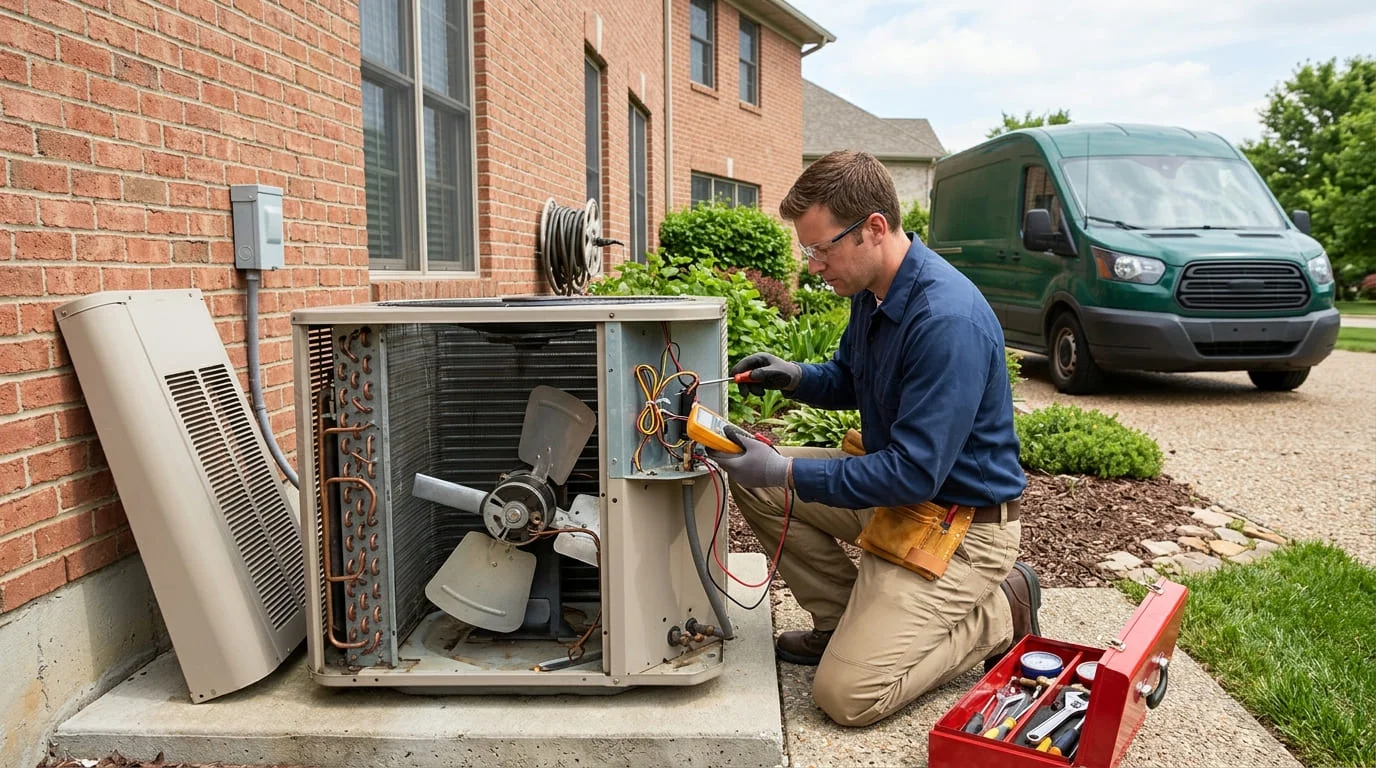
HVAC repairs in Dublin cover condensate drain clearing and treatment, thermostat replacement and wiring, duct leak sealing and re-hanging, register and return grille work, float switch testing, filter and coil access, and room-by-room airflow diagnosis. We carry mastic, foil tape, drain fittings, thermostats, and common float switches on the truck.
Our scope stops at the sealed refrigerant system. Charging refrigerant, replacing a compressor, or repairing a line set requires EPA 608 certification, and when a diagnosis lands there we say so plainly and do not charge for the visit that produced the referral.
Because Dublin is a fifty-minute run, we book a confirmed day and arrival window rather than a vague promise, and we would much rather handle a whole property's list in one trip than make several. There is no travel surcharge either way.
Why Dublin Houses Are Hard to Keep Comfortable
Dublin houses are hard to keep comfortable for reasons that vary sharply by era, and the fix is usually cheaper than the homeowner is braced for.
High ceilings, retrofitted ducts, and long runs
A twelve-foot ceiling means roughly forty percent more air to condition than a modern eight-foot ceiling over the same floor area. Add the fact that warm air stratifies toward the top of a tall room, and a thermostat mounted at five feet is reading a layer of the room that does not represent the whole space.
Then there is the duct. These houses had no chases, no soffits, and no plan for mechanical systems, so when central air arrived the runs went wherever there was room — through crawl spaces, up through closets, along attic floors.
Those runs are long, and every foot in unconditioned space costs capacity. A joint that has separated somewhere along the way is simply conditioning the crawl space, and it will do that silently for years.
The encouraging part is the economics. Sealing accessible joints with mastic, re-hanging runs that are sagging, and replacing a crushed section of flex recovers real capacity for a small fraction of what new equipment costs.
Adding return air is the other lever in a tall-ceilinged house. A system that cannot pull air back efficiently cannot deliver it efficiently either, and undersized returns are close to universal in retrofitted historic houses.
Damp crawl spaces on the low ground
Dublin sits along the Oconee River on Coastal Plain sand, and the low ground near the river holds moisture that the higher sandy ground sheds.
Ductwork in a damp crawl space has a compounding problem. Cool supply air moving through humid space causes condensation on the outside of the duct, which soaks the insulation, rusts the straps and hangers, and eventually drops the run onto the ground.
Worse, any leak on the return side of that system is actively drawing damp crawl space air into your house. That is an efficiency loss, a comfort problem, and an indoor air quality issue all at once, and homeowners usually notice it as a musty smell they cannot locate.
So when we are under a Dublin house we look at the vapor barrier and the drainage along with the duct. Sealing the duct without addressing standing moisture treats one symptom of a condition that will keep producing them.
The ranch belt and the replacement decision
Dublin's 1950s through 1970s ranch stock and the 1990s and 2000s subdivisions present a more conventional picture: normal ceiling heights, ducts designed in rather than retrofitted, and systems now reaching the age where replacement enters the conversation.
Our role there is to keep the decision honest. We do not sell equipment, so we have nothing to gain from telling you a system is finished.
A twenty-year-old unit with a drain clog, a bad thermostat, a failed capacitor, or a duct fault is worth repairing without hesitation. The same unit with a failed compressor or a leaking coil is a different question, because that repair costs a real fraction of replacement and leaves you owning an old system. We will tell you which one you have.
How HVAC Repair Works — Step by Step
HVAC repair works in four steps, and following them in order is what prevents an unnecessary equipment quote.
- First, separate a water problem from a cooling problem. A ceiling stain, a musty smell, a system that runs without cooling, and a system that will not start are four unrelated diagnoses. We establish which is in front of us before touching anything.
- Second, check the inexpensive causes first. Filter, drain line, float switch, thermostat, breaker, and disconnect. Fifteen minutes of sequence resolves a large share of no-cooling calls outright, and it costs you almost nothing to rule them out.
- Third, measure the air instead of guessing. Supply and return temperature split shows whether the system is removing heat. Room-by-room airflow shows whether the duct is delivering it. In Dublin's retrofitted historic stock those two numbers routinely disagree, and the disagreement is the answer.
- Finally, repair and run it under load. Drains get flushed and watched. Sealed joints get checked with the blower running. Nothing is finished until the room that was uncomfortable has actually changed temperature — which matters more at this distance, because we are not fifteen minutes away if it has not.
What Every Dublin HVAC Visit Includes
- A confirmed day and arrival window, booked rather than approximated
- Diagnosis separating drainage, distribution, and equipment faults before parts are ordered
- Crawl space or attic duct inspection, with vapor barrier and moisture noted while we are there
- Condensate drain clearing, flushing, and treatment with materials carried on the truck
- A straight repair-or-replace opinion with the reasoning, and no equipment to sell you
- A free written estimate with no travel surcharge, and a one-year workmanship warranty
HVAC Repair Cost in Dublin, GA
HVAC repair costs in Dublin track Middle Georgia rates, and the distance from Macon adds no surcharge. Condensate drain clearing and flush runs $95–$185. Thermostat replacement including wiring is $125–$275. Duct leak sealing and re-hanging on accessible runs is $150–$450. Register, boot, and return grille repair runs $85–$200. A full seasonal service visit is $125–$195.
Access drives the price more than anything else here. A tall, dry, reachable crawl space is straightforward duct work. A low crawl space with standing moisture is slower, dirtier, and priced accordingly — and in that case the drainage is worth fixing before the duct, because otherwise the same repair comes back.
For how we price work across job types, see our Middle Georgia handyman pricing guide.
Serving Dublin, East Dublin, and Laurens County
We cover Dublin in full — downtown, the Bellevue Avenue historic district, the Oconee River area, East Dublin, and the hospital corridor around Fairview Park and the VA campus, throughout the 31021 ZIP code. Dublin sits about 50 minutes east of Macon on I-16, and that straight shot is what makes serving Laurens County properly practical.
We also cover Eastman to the south, and can handle multiple trades on one visit — see our Dublin plumbing repairs and electrical work in Dublin. If a musty smell turns out to be more than duct, we handle mold removal too, or see everything we handle for Dublin homes →
House that never gets comfortable, or a musty smell you can't place? Let's look at the ductwork first.
HVAC Questions from Dublin Homeowners
Have a question not listed here? Call us at (877) 368-1249 and we'll answer it directly.
- Yes. Handyman Macon GA handles the HVAC work that does not require opening a sealed refrigerant system — condensate drain clearing and treatment, thermostat replacement and wiring, duct leak sealing and re-hanging, register and return grille work, float switch testing, filter and coil access, and airflow diagnosis. Dublin is about 50 minutes east of Macon on I-16, so we book a confirmed day and arrival window. Refrigerant charge and compressor work requires EPA 608 certification and we refer it.
- Three things stack up in the Bellevue Avenue era stock. The ceilings are high, so there is far more air volume to condition than the floor area suggests. The system was retrofitted into a house never designed for ducts, so the runs are long and often travel through unconditioned crawl space or attic. And the original windows and the building envelope leak more than modern construction does. The good news is that the duct losses are usually the largest single factor and the cheapest of the three to correct.
- Condensate drain clearing and flush runs $95 to $185. Thermostat replacement including wiring is $125 to $275 depending on the unit. Duct leak sealing and re-hanging on accessible runs is $150 to $450 depending on how many joints need attention. Register, boot, and return grille repair runs $85 to $200. A seasonal service visit covering filter, coil access, drain treatment, and airflow check runs $125 to $195, and there is no travel surcharge on a Dublin quote.
- It does, through the crawl space, and it is worth understanding. On the low ground near the Oconee River the crawl space holds moisture, and ductwork running through damp space has two problems rather than one. Cool supply air passing through humid space sweats on the outside of the duct, which soaks insulation and eventually rots the hangers. Any leak on the return side then draws that damp crawl space air into the house. Sealing the duct improves comfort, efficiency, and indoor air quality at the same time.
- It depends entirely on what failed, and we have no equipment to sell you either way. A clogged condensate drain, a bad thermostat, a failed capacitor, or a duct problem is worth repairing on a twenty-year-old system without hesitation, because the repair is cheap relative to replacement and buys real years. A failed compressor or a leaking evaporator coil is different — that repair costs a meaningful fraction of a new system and leaves you owning an old one. We tell you which side of that line you are on before you spend.
- Spring, before the cooling season. Dublin has a long, hard cooling season and a short, mild heating one, and nearly every HVAC failure that causes actual property damage here is a cooling-season event — a clogged condensate line overflowing, a separated duct run, a float switch that was never going to trip. A spring visit that clears and treats the drain, tests the float switch, changes the filter, and measures the temperature split costs less than a single emergency call in July.