
How Much Does Fence Repair Cost in Macon, GA? (2026 Prices)
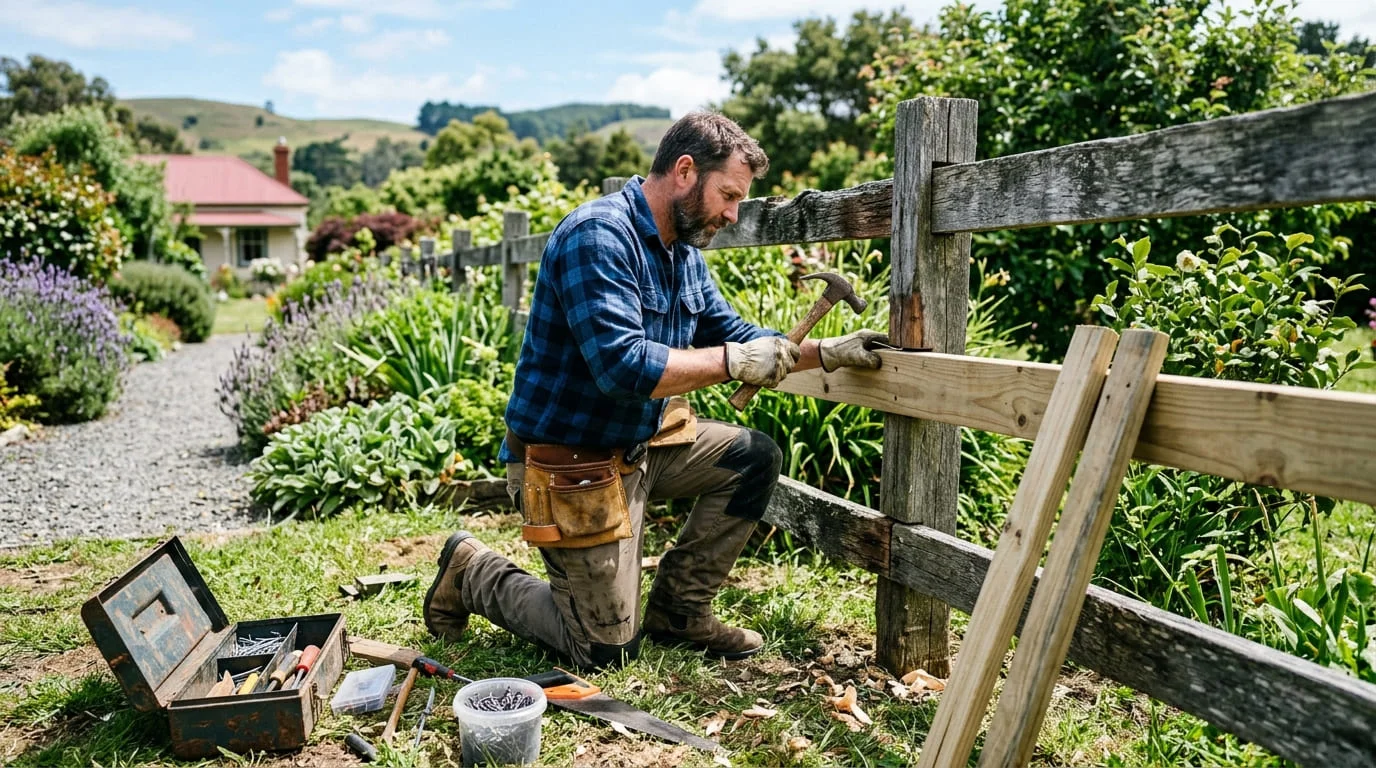
Fence repair in Macon, GA costs $180 to $650 for most jobs, with a single rotted post running $110 to $300 and a leaning section re-plumbed and reset running $180 to $550. Storm damage that takes out an entire run rebuilds at $30 to $55 per linear foot, and a full 150-foot wood privacy replacement runs $3,500 to $7,500.
Nearly all of that money goes into the ground. Central Georgia's red clay and 45 to 50 inches of annual rainfall put the failure point at the soil line, which is why the pickets on a twenty-year-old Macon fence often look fine while the fence itself is leaning into the neighbor's yard.
This guide breaks down what each repair costs in Bibb County, why posts fail here on a predictable schedule, and how to tell whether you are looking at a $200 afternoon or a replacement.
When Handyman Macon GA gets called about a fence, the first thing we do is push on every post — because that one test decides the entire estimate.
Fence Repair Cost in Macon — Quick Summary
| Repair | Typical Cost |
|---|---|
| Replace a single rotted post | $110 – $300 |
| Re-plumb and reset a leaning section | $180 – $550 |
| Replace individual pickets or boards | $8 – $20 per board |
| Replace a broken rail | $60 – $150 per rail |
| Gate realignment and hardware | $120 – $350 |
| Rebuild or replace a gate | $250 – $900 |
| Storm damage — rebuild a full run | $30 – $55 per linear foot |
| Chain link repair | $12 – $25 per linear foot |
| Vinyl panel replacement | $150 – $400 per panel |
| Clean, stain, and seal | $2.50 – $5.00 per linear foot |
| Full wood privacy fence replacement (150 ft) | $3,500 – $7,500 |
Labor in the Macon market generally runs $50 to $95 per hour for fence work, with a minimum service charge on small jobs.
Those minimums are why replacing one post rarely costs $60 even though the post itself is around $20 — the price reflects digging out a set post, breaking up an old concrete footing, setting and plumbing the new one, and reattaching rails that were never meant to come apart.
Why Fence Posts Fail First in Central Georgia
Fence posts fail first because of where decay is possible, and in Macon that is a narrow band right at the soil line. Wood-decay fungi need moisture and oxygen together. Below grade there is moisture but very little oxygen, and above grade there is oxygen but the wood dries out between rains.
The two-inch zone at grade has both, continuously, and that is where the post gives way.
Bibb County's red clay makes this considerably worse than it would be in sandy soil. Clay does not drain — it holds water against whatever is buried in it and releases it slowly, so a post here stays wet for days after a storm rather than hours.
Clay also swells when it takes on water and shrinks as it dries, and that seasonal movement works the post back and forth in its hole until the gap around it becomes a channel that funnels more water straight down to the buried portion.
Termites are the second factor, and Central Georgia sits in active subterranean termite territory. A wood post in ground contact is a feeding point, and a fence line running from the yard toward the house is a covered bridge to the structure.
This is why the treatment rating on a post matters more than the wood species. A post stamped for ground contact carries substantially more preservative retention than one rated for above-ground use, and the difference in the ground is measured in years.
Concrete is the third, and it is usually a self-inflicted problem. Concrete poured flat or dished around the base of a post creates a bowl. That bowl fills with rainwater and holds it against the wood indefinitely, so the post rots faster than it would have in bare clay.
Concrete crowned above grade so water sheds away from the post, over a few inches of gravel at the bottom of the hole for drainage, performs the way people expect concrete to perform. Handyman Macon GA pulls a lot of failed posts in Bibb County out of what amounts to a wet concrete cup.
How to Tell Whether to Repair or Replace
Telling repair from replacement takes ten minutes and no tools. Walk the fence line and push each post firmly at chest height, then count.
First, count the movers. If fewer than about a third of the posts move, repair is the right call. Those posts can be replaced individually and the fence goes back to being a fence.
If more than a third move, the remaining posts are the same age, the same lumber, and in the same clay — they are not going to behave differently, and you will be paying a service call every season.
Second, check the rails and pickets separately. Posts and pickets fail on different schedules. Sound pickets on failed posts is the most common pattern in Macon and it is very much worth repairing. Failed pickets on sound posts usually means sun and weather exposure rather than a structural problem, and replacing boards is inexpensive.
Third, apply the half-of-replacement rule. If the repair estimate lands above roughly half of what replacement would cost, replacement is the better spend. A repaired fence made of fifteen-year-old lumber has a short remaining life, and paying 60 percent of replacement price for it is a poor trade.
Fourth, look at the bottom rail and the ground clearance. Pickets touching soil or buried in accumulated leaf litter wick moisture upward and rot from the bottom. Where we find that, we usually recommend cutting the pickets back and correcting grade rather than replacing them, since the same thing will happen again otherwise.
Storm Damage and Macon's Fence Season
Storm damage drives a distinct repair season in Macon, and it arrives twice. Spring severe thunderstorms bring straight-line winds through Bibb County most years, and late summer into fall brings the remnants of tropical systems moving up from the Gulf — the 2024 Helene remnants pushed fence claims across Central Georgia sharply.
A privacy fence is essentially a solid sail. Six feet of continuous board catches wind that a picket or chain link fence lets pass through, and the load goes straight into posts that may already be compromised at grade. That is why storms rarely break a fence in the middle of a board — they lay over whole runs, hinging at the ground line where the posts were already weak.
Macon's mature tree canopy adds the other half of it. Falling limbs are the single most common cause of the localized, one-or-two-section damage we get called out for, and they tend to arrive in the same storms.
If a section is down and the fence is containing a dog or a pool, a temporary brace is a same-day job and worth doing while a full repair gets scheduled. We handle both, and the temporary work is not wasted — the bracing usually stays useful while the concrete on the new posts cures.
Costs by Fence Type in Macon
Pressure-treated pine is the default in Macon and the cheapest to repair, at $18 to $32 per linear foot for section work. It is locally available in every size, so matching material is never a problem, and a fifteen-year-old fence can be repaired with lumber that will weather to match within two seasons.
Cedar costs more to repair than pine — expect a 30 to 50 percent premium on materials — and matching weathered cedar is genuinely difficult. New cedar next to fifteen-year-old cedar is obvious for at least a year.
Cedar also carries a misconception worth correcting: cedar's rot resistance lives in the heartwood, and the sapwood common in fence-grade cedar has little of it. In ground contact, treated pine outperforms most cedar posts sold today.
Chain link is the cheapest to maintain at $12 to $25 per linear foot for repairs, and its failure mode is different. Chain link posts are galvanized steel set in concrete, so they rarely rot.
What fails is the fabric tension, the top rail at the couplings, and the gate hardware. Most chain link calls we take are re-tensioning and hardware rather than structural work.
Vinyl repairs at $150 to $400 per panel and cannot be patched — a cracked panel is replaced, not repaired. Long UV exposure makes older vinyl brittle, and Georgia sun delivers plenty of it, so a panel broken by a mower or a limb often cannot be matched exactly to sun-faded neighbors.
Aluminum and ornamental steel run $200 to $500 per section. These almost never fail in the panel. They fail at gate hinges, latches, and the fasteners connecting rails to posts, all of which are inexpensive parts on a straightforward service call.
What a Fence Repair Actually Involves
A proper post replacement follows the same sequence every time. First, the rails and pickets attached to the failed post are carefully detached so they can be reused rather than destroyed. Second, the old post and its concrete footing are dug out completely — leaving a broken footing in the hole means the new post cannot be set to the right depth or plumb.
Third, the hole is dug to roughly one-third of the post's above-ground height, which for a standard six-foot privacy fence means about 24 to 30 inches, and a few inches of gravel go in the bottom for drainage.
Fourth, the ground-contact-rated post is set, plumbed in two directions, and braced. Fifth, concrete is placed and crowned above grade so water sheds away from the wood rather than pooling against it. Finally, the rails and pickets are reattached and the line and height are checked against the neighboring sections.
The step most often skipped is the second one. Digging out an old concrete footing in Macon clay is genuinely unpleasant work, and a repair that sets a new post beside the old footing instead of removing it will lean again within a couple of years.
DIY vs Hiring a Pro
Replacing pickets and boards is a solid DIY project. The material is inexpensive, the fasteners are simple, and a mistake costs a $12 board. Staining and sealing is similarly approachable and is the highest-return maintenance available on a wood fence in this climate — it will not stop ground-line rot, but it substantially slows surface weathering and checking.
Post replacement is where DIY gets hard, and the difficulty is not skill. It is digging. Removing a set concrete footing from Central Georgia clay by hand is a serious afternoon, and doing four of them is a weekend most people only attempt once. Setting a post truly plumb and on line with its neighbors also matters more than it sounds — a post out of line by an inch shows across the whole run.
Anything involving a property line is worth a professional conversation before work starts. Fence height and placement in residential areas fall under Macon-Bibb County zoning, and limits generally differ between front and rear yards. Confirming the requirement with Macon-Bibb Planning and Zoning before rebuilding a fence in a new location is a five-minute call that occasionally saves a rebuild.
Get a Fence Repair Estimate in Macon
An accurate fence number requires walking the line, because the only question that decides the price — how many posts have failed at grade — cannot be answered from a photograph. Call (877) 368-1249 or use the contact form to schedule a free estimate. We push every post, count the failures, tell you plainly whether this is a repair or a replacement, and put the number in writing before anything starts.
Our fence repair service in Macon covers wood, chain link, vinyl, and aluminum across Bibb County, including storm damage and same-day temporary bracing. The same ground-line moisture problem drives what we see in East Macon's river-side neighborhoods, and it is closely related to the causes behind deck repair costs in Macon. Houston County homeowners can find the same work on our fence repair in Warner Robins page.
Frequently Asked Questions
- Most fence repairs in Macon run $180–$650. A single rotted post costs $110–$300 depending on depth and whether it was set in concrete. Re-plumbing and resetting a leaning section runs $180–$550. Individual pickets run $8–$20 per board installed. Storm damage taking out a full run rebuilds at $30–$55 per linear foot. Labor generally runs $50–$95 per hour with a minimum service charge.
- Because that is the only place with both moisture and oxygen. Below grade the soil is too oxygen-poor for rapid decay, and above grade the wood dries between rains. The two-inch band at grade stays damp and aerated, exactly what decay fungi need. Red clay makes it worse by holding water against the post instead of draining, and 45–50 inches of annual rain keeps recharging it. That is why a post looks sound on top and snaps at your ankle.
- Repair when fewer than roughly a third of the posts have failed and the rails and pickets are sound. Replace when more than a third move, because the rest are the same age in the same soil and will fail on a similar schedule. Walk the fence and push each post at chest height, then count. If repair costs more than about half of replacement, replacement is the better spend in Macon's climate.
- Only when installed correctly, and in Macon it frequently is not. Concrete poured as a collar that cups around the post creates a bowl holding water against the wood, which accelerates rot. Concrete crowned above grade so water sheds away, with the post bearing on gravel below for drainage, performs well. Many failed posts we pull in Bibb County come out of a concrete bowl full of standing water and wet clay.
- Yes, and Central Georgia is active subterranean termite territory. A wood post in ground contact is a direct feeding point and, more importantly, a bridge — a fence running from the yard to the house gives termites a protected route toward the structure. Pressure-treated pine rated for ground contact resists this far better than untreated or above-ground-rated lumber, which is why the treatment stamp matters more than the species.
- A pressure-treated pine privacy fence typically lasts 12–18 years in Macon, and the posts almost always fail before the pickets. Cedar runs slightly longer above ground but is not better in ground contact unless it is heartwood. Vinyl and aluminum outlast both and fail differently — vinyl becomes brittle under long UV exposure and cracks on impact, while aluminum mostly fails at fasteners and gate hardware rather than in the panels.