
Handyman vs. Licensed Contractor: Which One Do You Actually Need in Macon, GA?
Hiring the wrong type of professional costs money in two ways — overpaying for a contractor when a handyman would do, or underpaying for a handyman when the job needs a licensed pro. Here's how to tell the difference.
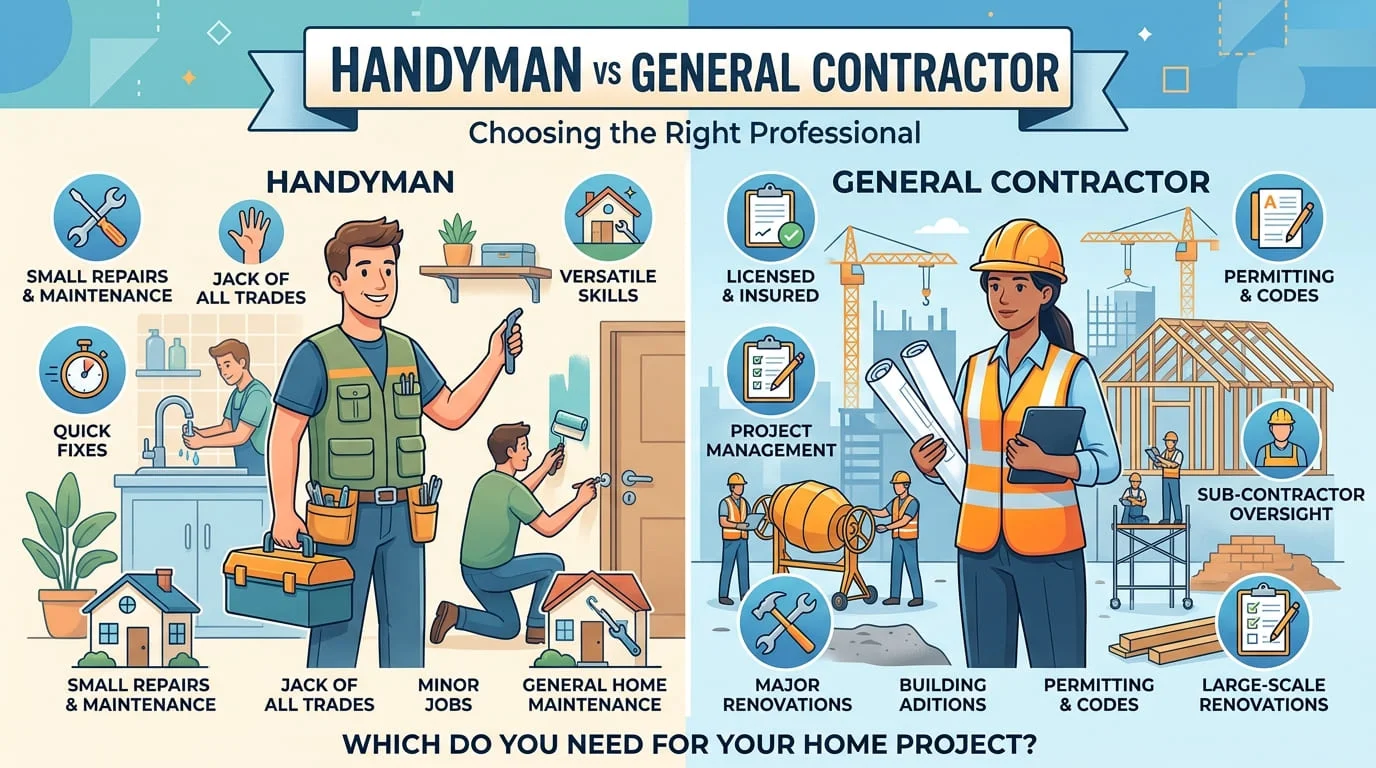
Every Macon homeowner faces this question eventually: the project is more than a simple fix, and you're not sure whether to call a handyman or hire a licensed contractor. The wrong call in either direction costs you — either you pay contractor rates and overhead markups for work a qualified handyman could have handled for less, or you hire a handyman for scope that genuinely required a licensed professional and end up with work that doesn't pass inspection.
The difference isn't about the difficulty of the work — it's about licensing requirements, permit obligations, and the scope of liability involved. Here's a practical breakdown of how it works in Macon, GA and across Bibb and Houston Counties.
What Is a Handyman, Exactly?
A handyman is a skilled generalist who handles home repair, maintenance, and improvement tasks across multiple trades — carpentry, painting, drywall, plumbing fixtures, electrical fixtures, flooring, tile, and more. In Georgia, handymen can legally perform work that doesn't require a specific trade license (plumbing, electrical, HVAC) and doesn't require a general contractor license.
Georgia law generally does not require a general contractor license for repair, maintenance, or improvement work under $2,500 total project value. For larger projects that are repair or maintenance in nature — not new construction or additions — a handyman operating as a sole proprietor or under a business can often legally perform the work. The line gets clearer when permits get involved: anything that requires a building permit from Bibb County or Houston County typically requires a licensed contractor to pull that permit.
What this means practically: a handyman can replace your bathroom vanity, retile your shower, hang drywall, replace windows, install doors, paint your entire house, and repair your deck — legally, properly, and usually for significantly less than a licensed general contractor would charge for the same scope.
What a Licensed General Contractor Does Differently
A licensed General Contractor (GC) in Georgia carries a state license, a surety bond, and typically significant liability insurance. They're qualified to pull building permits, manage subcontractors across multiple licensed trades, and take on construction projects that involve structural work, additions, new buildings, or any scope that requires county permits.
The GC adds two things a handyman doesn't: the legal authority to pull permits and manage licensed subcontractors, and a layer of bonded accountability that provides additional recourse if the work goes wrong. For the right project, that's worth the premium. For a bathroom refresh, a drywall repair, or a deck repair — it's overhead you're paying for unnecessarily.
The Decision Framework: Use This to Figure Out Which You Need
Call a Handyman for:
- Drywall repair, patching, and finishing
- Interior and exterior painting
- Flooring installation and repair (hardwood, LVP, tile, carpet)
- Tile installation — kitchen backsplash, bathroom, shower surround
- Door installation and repair (interior and exterior, pre-hung and slab)
- Window repair and replacement (standard sizes)
- Deck repair and maintenance
- Fence repair and installation
- Carpentry — trim work, crown molding, shelving, built-ins
- Fixture installation — light fixtures, ceiling fans, bathroom fixtures
- Outlet and switch replacement (not new circuits)
- Faucet and toilet replacement (not moving supply or drain lines)
- Kitchen and bathroom remodeling that doesn't involve moving walls or plumbing
- Pressure washing, gutter cleaning, general exterior maintenance
- Furniture assembly, TV mounting, grab bar installation
Call a Licensed General Contractor for:
- Home additions (adding square footage to the structure)
- Structural changes — removing load-bearing walls, beam installation
- New construction and major renovations requiring building permits
- Roof replacement (typically requires a licensed roofing contractor in Georgia)
- Foundation work
- Large remodels where plumbing or electrical is being moved and permits are required
Call a Licensed Plumber for:
- New plumbing installation (rough-in for additions or new construction)
- Main water line and sewer line work
- Gas line installation or repair
- Water heater replacement (typically requires a permit in Georgia)
- Any work requiring a plumbing permit from the county
Call a Licensed Electrician for:
- New circuit installation (running wire from the panel to new locations)
- Electrical panel upgrades and sub-panel installation
- Service entrance work
- Any work requiring an electrical permit from Bibb or Houston County
The Honest Middle Ground: Hybrid Projects
Many projects in Macon and Warner Robins homes are hybrid — part handyman scope, part licensed trade scope. A full kitchen remodel might involve a licensed plumber to rough in a new island sink location, a licensed electrician to add a circuit for new appliances, and a handyman (or the GC's carpentry subs) to do the cabinet installation, tile backsplash, flooring, and trim work.
In these cases, a GC often makes sense as the project coordinator — they manage the sequencing of the licensed subs and take overall accountability. But for smaller hybrid jobs (a bathroom remodel that just needs the plumbing connections touched without moving anything), Handyman Macon GA can handle the full scope and refer just the permit-requiring pieces to licensed trades we trust, so you're not paying GC overhead on the entire project.
What Handyman Macon GA Handles in Macon and Warner Robins
We've been the handyman for Macon and Warner Robins homeowners since 2010. Our scope covers virtually everything on the "call a handyman" list above — drywall, painting, flooring, tile, carpentry, doors, windows, deck work, plumbing fixtures, electrical fixtures, and full bathroom and kitchen remodels that don't require structural changes.
We're direct about the line. If you call us with a project that needs a licensed contractor or a licensed trade professional, we'll tell you — and we can often connect you with someone we trust rather than leaving you to start the search over. We don't take work outside our scope and then figure it out as we go. That's how homeowners end up with work that fails inspection or causes problems later.
Call us at (877) 368-1249 and describe your project. We'll tell you in 5 minutes whether it's a handyman job, a licensed contractor job, or something in between — and give you a straight opinion on the best path forward.
The Cost Difference: What You Actually Save
A licensed general contractor typically builds in 15–25% project overhead plus subcontractor markups. On a $3,000 bathroom refresh, that might add $450–$750 to the total — for the same physical work. On larger projects, the savings from working directly with a skilled handyman (when the scope is genuinely within handyman range) compounds significantly.
The caveat: don't hire a handyman to save money on work that genuinely requires a licensed contractor. A renovation that needed permits and didn't get them can create problems at resale — buyers' agents pull permit history, and unpermitted work can delay or derail a sale. Call the right professional for the right scope, and you'll come out ahead both financially and in terms of work quality.
Frequently Asked Questions
- In Georgia, handymen can legally perform a wide range of home repair and maintenance tasks without a general contractor's license — including drywall repair and installation, painting, flooring installation and repair, tile work, carpentry, door and window replacement, fixture installation, and most maintenance tasks. Georgia does not require a general contractor license for jobs under $2,500 in total cost. For jobs over that threshold, a licensed contractor is typically required. Specific trade work — plumbing installation, electrical panel work, HVAC installation — requires the appropriate trade license regardless of project size.
- For most common home repairs and maintenance tasks in Macon, GA, yes — significantly so. A licensed general contractor typically charges 15–25% of the project cost as overhead markup on top of the actual work, plus subcontractor markups. A handyman prices the job directly. For a $500 repair, the difference can be $100–$200. For a $3,000 project, that difference compounds. The tradeoff is that contractors carry bonds and licenses that provide additional legal recourse — which matters for large or complex projects but is less relevant for a faucet replacement or a drywall patch.
- You need a licensed contractor (or the appropriate licensed trade professional) when: (1) the job requires a permit from Bibb County or Houston County — new construction, additions, most electrical panel work, HVAC installation; (2) the project exceeds $2,500 in Georgia and isn't maintenance or repair in nature; (3) the scope involves structural changes to the home (removing load-bearing walls, foundation work, roof replacement); (4) it involves licensed trade work — new electrical circuits, gas line work, main plumbing line replacement.
- Yes, and we'd rather you call to ask than hire the wrong type of professional for the job. We'll walk through your project and tell you directly what falls within our scope and what requires a licensed contractor, plumber, or electrician. We don't take jobs that are outside our scope and expertise — and we can often refer you to licensed professionals we trust in Macon and Warner Robins for the work we don't do.
Handyman Macon GA · Serving Macon & Warner Robins
(877) 368-1249
Mon – Sat · 7:00am – 7:00pm · Free estimates · Licensed & insured
Call — We'll Tell You What You Need