
Trusted Electrical Repair in Fort Valley, GA — Layered Downtown Panels and Rental Turnover Near FVSU
Electrical work in Fort Valley, GA starts at $95 for an outlet or switch replacement and runs to about $300 for a ceiling fan installed where no box exists yet. Handyman Macon GA works Peach County's older, more historic housing stock — panels layered with added circuits for decades — plus the rental turnover cycle around Fort Valley State University. About 30 minutes from Macon via I-75 and GA-49.
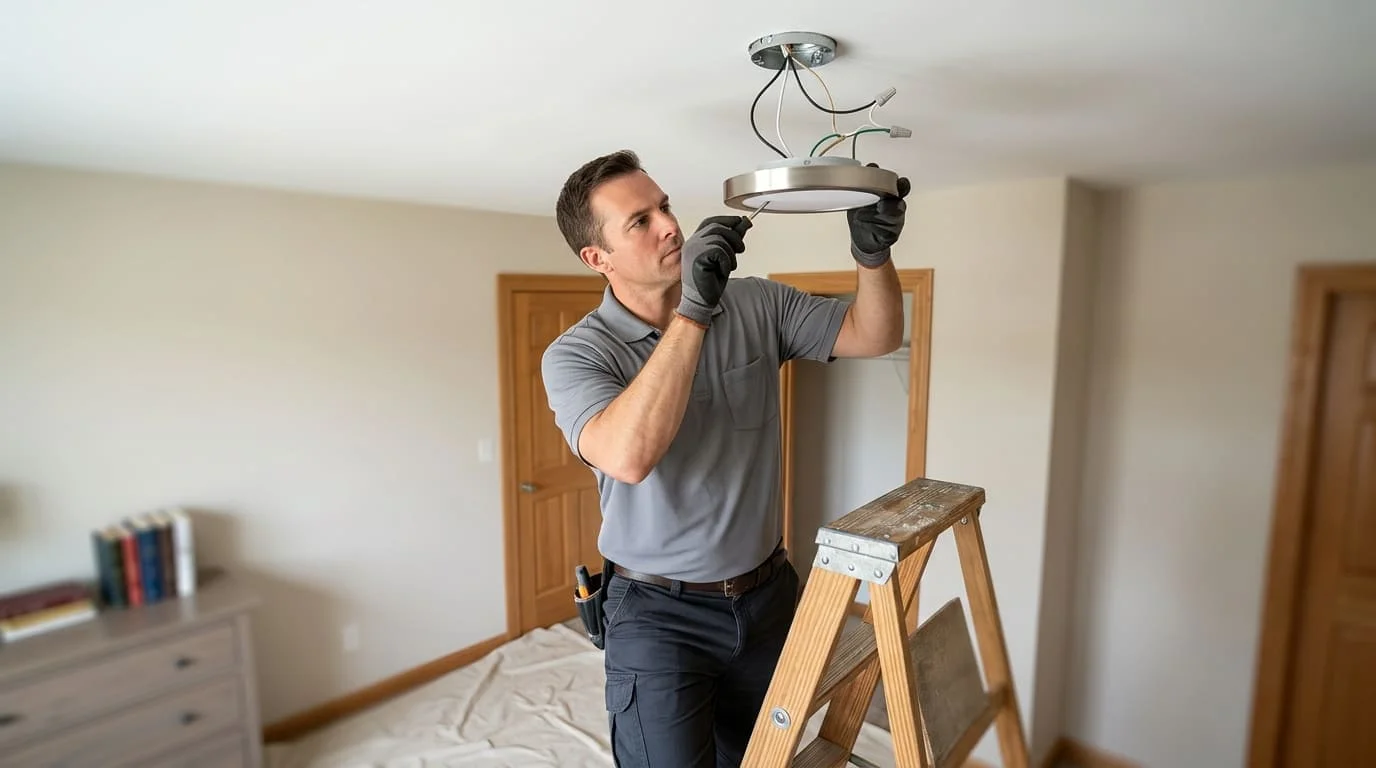
Fort Valley's electrical calls trace back to the same fact that shapes the rest of the town's repair work: this is an older housing market than most of the towns south of Macon, with a real turn-of-the-century downtown and comparatively little new subdivision growth. Panels here have typically been added to for generations rather than installed to a single modern code, and a meaningful share of the housing sits in a rental market built around Fort Valley State University, which adds its own wear pattern on top.
Electrical Services We Handle in Fort Valley
Electrical services in Fort Valley cover outlet and switch replacement, light fixture installation, ceiling fan installation and replacement, dimmer and smart switch work, GFCI and AFCI installation and troubleshooting, exterior and security lighting, appliance circuit diagnosis, and tracing circuits that trip for no obvious reason.
Here's where our scope stops, stated plainly. Service entrance work, meter bases, panel replacement, and new circuits requiring a permit belong to a licensed electrician. As the Peach County seat, Fort Valley is also where permits for the surrounding towns get pulled, so we always know exactly where to point a homeowner who needs one.
Why Fort Valley Homes Have the Electrical Problems They Do
Two separate forces shape Fort Valley's electrical calls, and they often overlap on the same street.
Downtown and the historic core: a century of added circuits
A house built in Fort Valley's historic core a hundred years ago was wired, if at all, for a few lights. Everything since — refrigeration, laundry, window units, central air — arrived as an addition to a panel that had no plan for any of it.
The result is a panel carrying more load than it was designed for, often with several eras of wiring method meeting inside it. Lights dimming when a large appliance starts is the classic symptom of that layering, a voltage-drop event rather than a fault by itself. Pronounced flickering, a breaker that trips repeatedly on one circuit, or a warm cover plate is different and worth prompt attention.
We also find plenty of ungrounded two-prong receptacles swapped for three-prong outlets at some point without ever running a ground — a fix that looks complete and isn't, and one we correct with proper GFCI protection or an actual ground where it's accessible.
Rental turnover near Fort Valley State University
The rental market around FVSU puts a different kind of stress on an old panel: several tenants sharing a house, each running a window unit, a space heater, or a hair dryer on circuits an early-1900s panel was never sized for multiple simultaneous loads. Breakers that trip repeatedly in a shared rental are often a load problem rather than a wiring defect, and the fix ranges from redistributing what's plugged in to adding a dedicated circuit.
The other regular job is turnover work — a landlord wanting every outlet, switch, and smoke detector checked and any deferred repair handled in one visit before a new lease starts. We scope those visits for landlords on a schedule that fits between leases, not a one-fixture-at-a-time timeline.
How Electrical Troubleshooting Works — Step by Step
Electrical troubleshooting works in four steps, and the discipline of the sequence is what keeps a diagnosis honest.
- First, establish what is actually on the circuit. A breaker that trips is doing its job, and the question is what's asking too much of it. In a shared rental that answer is often "more than the lease accounts for."
- Second, test the devices rather than trusting them. Outlets get checked for correct polarity, actual grounding, and loose terminations. A device that looks fine and tests wrong is the most common finding in Fort Valley's older stock.
- Third, separate a device fault from a wiring fault. Replacing a failing receptacle is a small job. A wiring problem inside a century-old wall is a different conversation with a different cost.
- Finally, repair and verify under load. Devices get tested after installation with the circuit energized and loaded, not just visually checked. Fixtures and fans get checked for secure mounting to a rated box.
What Every Fort Valley Electrical Visit Includes
- Circuit mapping before any device is condemned
- Testing for correct polarity and actual grounding, not just whether the outlet works
- Multi-fixture turnover visits scoped for landlords between leases
- A clear statement of which work needs a licensed electrician and a permit, at no charge
- Old devices and packaging removed from the property
- A free written estimate before work begins
Electrical Cost in Fort Valley, GA
Electrical costs in Fort Valley reflect Middle Georgia labor rates. Outlet or switch replacement typically runs $95–$165 for the first device, with additional devices on the same visit costing less. Light fixture replacement is $125–$250 depending on ceiling height and fixture weight. Ceiling fan installation where wiring and a rated box already exist runs $150–$300. GFCI installation is $135–$225.
Multi-unit turnover visits typically cost less per fixture than one-off calls, since travel and setup are shared across several outlets and switches in the same house. For how our pricing works across job types, see our Middle Georgia handyman pricing guide.
Serving Fort Valley, Fort Valley State, and Peach County
We cover all of Fort Valley — the historic downtown, the university district, and the Highway 96 corridor — along with Byron and Roberta across Peach and Crawford Counties. Fort Valley is about 30 minutes from Macon via I-75 and GA-49, close enough that a tripping breaker gets a same-day answer.
We also handle plumbing and mold removal in Fort Valley, and work nearby in Byron. Or see everything we handle for Fort Valley homes →
Breaker tripping, outlet dead, or a fan that needs hanging in Fort Valley? Let's take a look.
Electrical Questions from Fort Valley Homeowners
Have a question not listed here? Call us at (877) 368-1249 and we'll answer it directly.
- Yes. Handyman Macon GA handles residential electrical work throughout Fort Valley and Peach County — outlet and switch replacement, light fixture and ceiling fan installation, dimmer and smart switch work, GFCI and AFCI troubleshooting, exterior and security lighting, and diagnosing circuits that trip. Fort Valley is about 30 minutes from our Macon base via I-75 and GA-49. Service entrance work, panel replacement, and new circuits that require a permit are a licensed electrician's scope, and we say so rather than working past the line.
- Age, mostly. Fort Valley has an older, more historic housing stock than most towns south of Macon, with a real turn-of-the-century downtown and comparatively little new subdivision construction. A lot of that housing was wired for a handful of lights originally and has had circuits layered onto the same panel for decades since — ungrounded outlets and undersized service are common in the oldest houses.
- Outlet or switch replacement typically runs $95 to $165 for the first device and less for additional devices on the same visit. Light fixture replacement is $125 to $250 depending on height and complexity. Ceiling fan installation where wiring and a rated box already exist runs $150 to $300, and more if a box has to be added. GFCI installation is $135 to $225.
- Yes, regularly. Rental houses near the university see a different kind of electrical wear than owner-occupied homes — multiple tenants running window units, space heaters, and hair dryers on the same undersized circuits an older house was never wired for, plus turnover visits where a landlord wants every outlet, switch, and smoke detector checked before the next tenant moves in. We work with Fort Valley landlords on that schedule.
- That's usually a panel and circuit capacity issue rather than a fault. Many of Fort Valley's older houses have a panel carrying more circuits than it was designed for, added on over decades. When a large motor load starts, it briefly pulls enough current to drop voltage across the panel, and you see it in the lights. Occasional slight dimming is common in this housing stock. Pronounced dimming, flickering, or a warm cover plate should be looked at promptly.
- Fort Valley is about 30 minutes from our Macon base via I-75 and GA-49. A burning smell, a scorch mark, or a warm cover plate gets a same-day response.